We build therapist websites and sell visibility plans, so we have an interest here. To keep this fair, every number below comes from one automated count we ran ourselves, the method and its limits are at the end, and we don’t rank the platforms. We publish totals only, so no practice is named.
The count at a glance. Share of the 1,576 homepages that loaded on September 10, 2026.
| Platform | Sites | Share | Kind |
|---|---|---|---|
| WordPress | 482 | 30.6% | General-purpose |
| Squarespace | 288 | 18.3% | General-purpose |
| Wix | 195 | 12.4% | General-purpose |
| GoDaddy | 99 | 6.3% | General-purpose |
| SimplePractice | 65 | 4.1% | Made for therapists |
| Brighter Vision | 35 | 2.2% | Made for therapists |
| Weebly | 35 | 2.2% | General-purpose |
| TherapySites | 32 | 2.0% | Made for therapists |
| Webflow | 23 | 1.5% | General-purpose |
| Duda | 15 | 1.0% | General-purpose |
| Showit | 7 | 0.4% | General-purpose |
| Not identified | 300 | 19.0% | Hand-built, rarer or unrecognized |
| Total | 1,576 | 100% |
Which platform do most therapist websites run on?
WordPress, on 482 of the 1,576 sites (30.6%). Squarespace was second with 288 (18.3%) and Wix third with 195 (12.4%), so those three ran 965 sites between them, 61.2% of the count. GoDaddy came fourth with 99 (6.3%). We counted GoDaddy by its own page files, so that row includes 23 sites that also carried a WordPress tag, most likely WordPress sites on GoDaddy hosting.
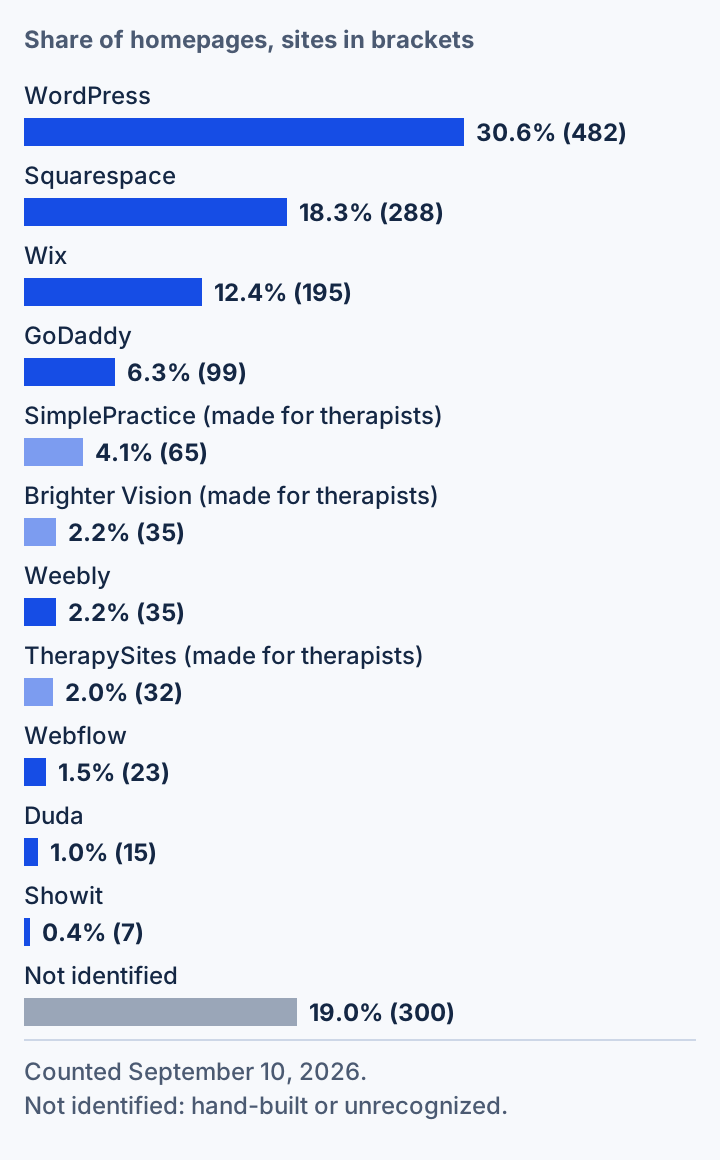
Weebly ran 35 sites (2.2%), Webflow 23 (1.5%), Duda 15 (1.0%) and Showit 7 (0.4%). The remaining 300 (19.0%) matched none of our checks. That group mixes hand-built sites, rarer builders and sites that hide their platform, and it also holds some pages that are not private practices at all, as the method section explains.
How many therapists use a website builder made for therapists?
132 of the 1,576 sites (8.4%) ran on one. SimplePractice ran 65 (4.1%), Brighter Vision 35 (2.2%) and TherapySites 32 (2.0%). General-purpose builders ran 1,144 (72.6%). Among the 1,276 sites whose platform we could identify, that is about nine general-purpose sites for every one made for therapists (89.7% against 10.3%).
The therapist services bundle things a general builder leaves to you, such as a booking link from your practice software or a design done for you, and they price that in different ways. Our comparison of website builders for therapists lists each one’s published prices, and our guide to what a therapist website costs adds hosting and upkeep.
One caution on the SimplePractice number: our check matched SimplePractice’s own page code, so a site on another builder that embeds a SimplePractice widget may be counted here. Seven of the 65 also carried a WordPress tag.
How many therapist homepages let a visitor book online?
225 of the 1,576 (14.3%) linked from the homepage to one of six online booking services: SimplePractice’s client portal, the TherapyNotes client portal, Calendly, Acuity Scheduling, Zocdoc or Jane. The others may still offer booking on an inner page, which this count doesn’t see.
| Platform | Sites | Homepage links to booking | Share |
|---|---|---|---|
| SimplePractice | 65 | 64 | 98.5% |
| Brighter Vision | 35 | 10 | 28.6% |
| Squarespace | 288 | 54 | 18.8% |
| Weebly | 35 | 5 | 14.3% |
| GoDaddy | 99 | 14 | 14.1% |
| Wix | 195 | 20 | 10.3% |
| TherapySites | 32 | 3 | 9.4% |
| WordPress | 482 | 37 | 7.7% |
| Not identified | 300 | 10 | 3.3% |
SimplePractice sites almost all link to booking because the link to its client portal comes with the site. On the general-purpose builders the link is something the therapist adds, and most homepages hadn’t. Rows with 35 sites or fewer can swing on a handful of sites, so read them loosely.
If your practice software takes online requests, our guides walk through adding SimplePractice booking and adding TherapyNotes, Jane or IntakeQ booking on each builder. If you would rather start with a message, our guide to what a contact form should ask covers the fields to keep.
How many link to Psychology Today or an insurance platform?
162 homepages (10.3%) linked to a Psychology Today profile. Only 10 (0.6%) linked to at least one of four insurance-billing platforms (Headway, Rula, Alma or Grow Therapy), and Zocdoc appeared on 10 (0.6%).
A directory profile and your own site do different jobs, and our guide to Psychology Today and your own website covers what each one does. If you are moving off a billing platform, see leaving an insurance platform.
How many therapist websites still load without HTTPS?
56 of the 1,576 (3.6%) ended on a plain http address, so the connection between the visitor and the site was not encrypted. The other 1,520 (96.4%) loaded over https. If your address starts with http://, ask your builder or host how to switch on HTTPS, especially if your site has a contact form.
What should you take from this if you’re choosing a platform?
That each of the three big builders runs hundreds of the sites in this count, so you won’t be alone on any of them. The count can’t tell you which platform brings more clients, and no platform does that by itself. What it does show is a gap almost any site can close: only about one homepage in seven linked to booking.
Whatever you build on, check three things on your homepage: your license details shown the way your board requires (California’s rule is in our guide to the 2026 advertising rule), your fee (see whether to list fees), and one clear way to get in touch.
How did we count, and what are the limits?
On September 10, 2026, a script requested each site’s homepage once, after checking the site’s robots.txt file, and read the page code. It identified the platform from the page’s generator tag and the addresses its files load from, checking the services made for therapists first and WordPress last, because many other platforms load WordPress files too. A homepage that matched none of the checks counts as not identified: hand-built sites, rarer builders, and sites on a platform we check for but customized enough to hide it.
The sites came from a sample of California mental health clinicians listed in the federal NPI registry, which CMS describes as “a free directory of all active National Provider Identifier (NPI) records,”1 narrowed to likely private practitioners whose practice websites we could find: 1,778 sites in all. 1,576 returned a page. The other 202 didn’t, through errors, timeouts or redirects, and 31 of them asked robots not to visit, which we respected.
- California only. Other states may look different.
- Therapists with a findable website. Practices without a site aren’t counted, so these are not shares of all therapists.
- Not every site is a private practice. Some pages belong to health systems, churches, counties or professional associations, and several of those sit in the not-identified row.
- Homepage only. A booking or directory link on another page isn’t counted.
- One day. Sites change platform, so this is a snapshot of September 10, 2026.
- Totals only. We name no practice, and we used no client data.
Questions therapists also ask
Does this show which platform is best for a therapist?
No. It shows what therapists use. For what each platform costs and includes, see our builder comparison and our Squarespace, Wix and WordPress comparison.
Why do so few homepages link to booking?
Page code can’t tell us. Some therapists want a call before anyone books, some put booking on a contact page, and some practices are full. Our guide from inquiry to first session covers what happens after someone reaches out.
Would a hand-built site show up as not identified?
Usually, unless it loads files from one of the platforms we check for. Our own sites are hand-built and would most likely land in that row.
Can I see which sites were counted?
No. We publish totals only, so no practice is named or ranked here.
Will this count be updated?
If we run it again, this page will show the new date and numbers next to these ones.
Where to start
Check your own homepage against the numbers above: whether it loads over https, whether it links to booking or another clear next step, and whether it shows your license details. If you would rather have a fully custom site of up to 10 pages built and kept current for you, from $149 a month ($119 a month billed annually) after a $499 design fee, find the plan that fits your practice.