We build therapist websites and sell visibility plans, so we have an interest here. To keep this fair, every price below comes from the provider’s own page, checked on October 22, 2026. Nobody is ranked, the tables are grouped by kind of help, and we list ourselves last. If you would rather do the work yourself, Google says a small local business “can probably do much of the work yourself,”1 and the retainer section below says when that is the better buy. Our SEO for therapists guide lays out that work step by step.
What do therapists pay for SEO help?
Published prices run from $97 for a short course to $3,500 a month for a retainer, and the number depends mostly on whether you are buying advice, one-time work or monthly work. The ranges below use only the providers whose own pages show a price.
Prices checked October 22, 2026
| Type of help | Published prices we found | What the providers below list |
|---|---|---|
| One-time audit, strategy or setup | $150 for a single page, $500 for a strategy or a small audit, up to $2,000 for a whole-site optimization | Keyword and competitor research, fixes to titles, headings and technical items, and a written plan |
| Monthly SEO retainer | $500 to $3,500 a month for solo and small practices, plus a one-time onboarding fee of $250 or $350 at two providers | Monthly page work, some writing, Google Business Profile work and a report |
| SEO bundled with a website platform | $99 to $349 a month | The website and hosting, with SEO work added in higher tiers |
| Course or do-it-yourself training | $97 to $999, paid once | Video lessons and templates, sometimes an audit or coaching |
| Hourly or per-session consulting | $250 a session; no hourly rate published | A strategy session or a coaching call |
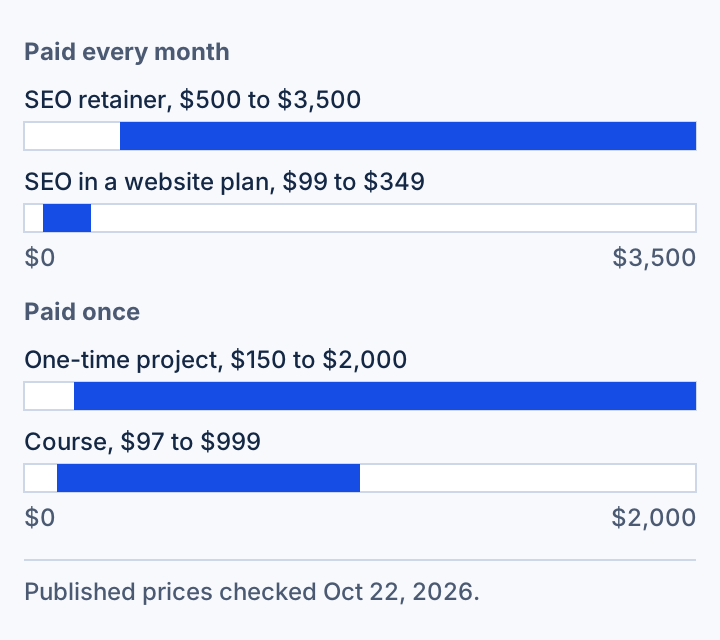
These are ranges from the providers in the next section, not market averages. Three things sit outside them. Onboarding fees are extra at Marketing for Therapists ($250) and Simplified SEO Consulting ($350).75 Writing can be extra too: Simplified lists full copywriting at $400 more a month.5 Paid ads are a separate bill: Core Stackr says ad spend is scoped separately.9 Two providers, Strong Roots and Brighter Vision’s SEO plans, publish no price, so they are in the table but not in the ranges.
What do you get at each price?
At $99 to $349 a month, SEO is part of a website plan; from about $500 to $3,500 a month, the plans pay for a specialist’s time on your site each month; one-time projects and courses sit below both. Providers are grouped by kind of help, not ranked, and each price is the provider’s own wording on the page cited.
| Provider | What you buy | Published price | Commitment or minimum term | Source |
|---|---|---|---|---|
| Simplified SEO Consulting, courses | Do-it-yourself video courses: a comprehensive SEO course (over 10 hours of video), a first-steps course, and courses on blogging and on backlinks | $749 (comprehensive), $97, $225 and $99, one time | No term stated | 6 |
| Copy with Ashley | SEO for Therapists 101 course, 3 to 4 hours of video and worksheets; the higher tier adds a personalized audit of your website within 3 months of purchase | $297 self-study; $497 with audit | No term stated; refund policy of 14 days | 19 |
| Place Digital | Optimize Your Practice course (27 lessons) and coaching sessions with an SEO specialist | $999 for the course; $250 per coaching session | No term stated | 18 |
| The Attuned Studio | Three separate buys: an SEO Growth Strategy (keyword and competitor research, a growth roadmap, a Search Console and internal linking review); SEO service pages or location pages; a 90-minute strategy session | $500 for the strategy; $150 per page; $250 for the session | One-time projects; timeline 1 to 2 weeks | 17 |
| Marketing for Therapists | A One-Time Optimization, or a Monthly SEO Plan in three tiers by number of therapists and locations | One-time: $750 to $2,000 by site size. Monthly: $600, $1,200 or $1,800, plus a $250 onboarding fee | 90-day initial commitment, then cancel with 30 days’ notice for monthly plans | 7 |
| Core Stackr | Monthly campaigns scoped by practice size, or one-off projects such as an audit, a profile review or a technical fix | Monthly: $1,199 to $3,500 for a solo or focused practice, $3,500 to $8,000 for a competitive or group practice. One-off: from $500 | Monthly term not published; one-off projects need no monthly commitment | 9 |
| TherapySites | A therapist website plan with SEO as a higher tier: Advantage (“SEO 1.0”), Premium (“SEO 2.0”), Premium Plus (adds “AI search optimization”); two Elite tiers add more. Custom SEO content is a separate add-on | Website design $199 one time. Advantage $99, Premium $158, Premium Plus $207, Elite $266 and Elite Plus $336 a month. Core ($69 a month) lists no SEO. Custom SEO content from $99 | Set in your service agreement; its terms say a 12-month minimum applies “if stated” there and early cancellation leaves the rest of the term owed | 121314 |
| Brighter Vision | Website plans (Start, Grow, Flourish) and “Thrive & Prosper”, its SEO plans, reached through a “Build Your Plan” link | Thrive and Prosper: not published (“Build Your Plan”). Flourish, which includes one optimized content page a month, is listed at $349 a month | Not stated on its pricing page | 15 |
| WebsiteTherapy | An AI-managed website whose monthly plan includes SEO page improvements, new articles and Google Business Profile upkeep; a higher plan adds its founder on call | Growth $99 a month; Concierge $199 a month | “No contract, cancel anytime” | 16 |
| Credible by Design | Monthly care plans: website care with no SEO production; one “Growth Priority” a month; two a month | $295, $795 and from $1,495 a month | Month to month | 8 |
| HiveSourced | Monthly SEO and Content Growth Plan: location-based service pages, blog posts, Business Profile management, technical monitoring, a monthly report | $500 a month | Not published | 10 |
| Strong Roots Web Design | Ongoing monthly SEO for therapy practices, scoped after a review of your website | Not published; the proposal states the fee | Initial six-month commitment | 11 |
| Simplified SEO Consulting, Done-For-You | Monthly on-page SEO and answer-engine work, a 60-minute monthly strategy session, a data dashboard | $1,350 (3 months), $1,250 (6), $1,150 (9) or $1,050 (12) a month, plus a $350 onboarding fee | A consecutive 3, 6, 9 or 12-month contract that it says it enforces; ending early is possible only in extreme circumstances, at a fee of at least $100 for each month left | 5 |
| Therapy Visibility | A fully custom website we design and look after, plus monthly work on your pages, your profiles and how AI tools describe you, with a monthly report | Visibility $349 a month and Active Visibility $599, after a $799 design fee; 20% less billed annually | Month to month | Our pricing page |
Two cautions on reading the table. First, the same words can mean different work. TherapySites’ pricing page labels one tier “SEO 1.0” and the next “SEO 2.0” without saying what separates them, so ask for the difference in writing. Second, a platform tier and a specialist retainer are different products: one is a website with SEO work listed as part of the plan, the other is a person’s monthly time. For what that monthly time should consist of, see what good SEO and AI visibility work looks like.
Is a monthly retainer worth it, or is a one-time setup enough?
A retainer is worth it when you have no hours to write and review pages each month and you can name the pages and profiles you want built; a one-time setup, a course or a platform tier is enough when you can keep up the routine yourself. Google’s own advice points the same way: for a small local business, you “can probably do much of the work yourself,” and “a great time to hire is when you’re considering a site redesign (the earlier, the better), or planning to launch a new site.”1
Here is how the cheaper options fit, from least to most spent:
- You have a site and a few hours a month. A course ($97 to $999 in the table) or a one-time strategy ($500) gives you the list of what to fix, and you do the work. This is the cheapest route that still gets an expert’s eyes on your site.
- You are choosing a website platform anyway. A platform tier at $99 to $349 a month costs less than any retainer in the table, but ask exactly what it does each month, because the TherapySites pricing page, for one, lists tier names such as “SEO 1.0” rather than pages delivered. Our guide to what a therapist website costs compares the platforms themselves.
- The foundations are missing. If the site has no service pages, no Search Console and no Business Profile, a one-time project ($150 per page, $750 to $2,000 for a whole-site pass) fixes that without a commitment.
- You want the work done every month. This is what a retainer buys: someone accountable for a monthly list. It costs the most, and several of the published terms ask you to stay for a set period.
Providers say this themselves. Strong Roots lists situations where it would suggest a different starting point, including “You need new clients immediately,” “Your website needs substantial repair or rebuilding” and “The monthly investment would put your practice under strain,” and adds that “a smaller starting point or doing some of the work yourself may be more workable.”11 Google adds a reason to pick the shorter term first: some changes “might take effect in a few hours, others could take several months,” so a shorter first term lets you check the work before you commit further.20
What we do differently. On Visibility we improve one page or profile every month and record why we chose it and how we checked it, and each quarter we ask ChatGPT, Google’s AI and others the questions your future clients ask, then fix the sources behind wrong answers when we can. Active Visibility adds a new service, specialty or state page every month, Google Business Profile management and up to 10 directory listings. We follow changes in search and AI, try new methods where they make sense, and don’t promise rankings.
We are the wrong choice in several cases. Our plans are built around a website we design, so if you want SEO work on a site you are keeping, a one-time project or a specialist retainer in the table fits better. If all you want is a course or a paid strategy session, we don’t sell those. If a platform tier covers what you need, you do not need our visibility plans. We are a fit when you want the website and the monthly work from one studio; our pricing page has the plans and the terms.
What should the contract say?
It should say, in numbers and nouns, what you receive each month, who owns every account, how long you are committed, what reports show, who approves what is published, and what you take with you if you leave. Copy this checklist into an email or a proposal request, and ask for each answer in writing before you pay.
- What is delivered each month. Count things: pages written or changed, profiles corrected, hours of edits, calls held, a report. “Ongoing optimization” is not a deliverable. Specific wording looks like “One Growth Priority per month” or a “60-minute strategy session” each month, both taken from providers’ own pages.85
- Who owns the accounts. You should be the owner of Google Search Console, your Google Business Profile, your analytics property and the domain registration, with the provider added as a user or manager. Our local SEO and Google Business Profile guide covers setting up the profile yourself. Google describes the Search Console owner as someone who “has full control over properties” and can “add and remove other users,” and says of Business Profiles that “only profile owners can control who has access.”43 For an audit, Google advises granting “read access to Search Console” and not write access at that stage.1
- Minimum term, renewal and cancellation. Ask for the number of months, whether the contract renews on its own, how much notice you give, and what leaving early costs. In the table above, published terms run from no contract (WebsiteTherapy) or month to month (Credible by Design) to 90 days (Marketing for Therapists), six months (Strong Roots) and 3 to 12 months (Simplified SEO Consulting).1687115 TherapySites’ terms add a cancellation deadline of the 16th of the month.14
- Every fee. Onboarding, copywriting, third-party tools, directory fees and ad spend, each with an amount. Google warns about “deceptive pricing” and advises getting “an official copy of your agreement that clearly details the services and their costs.”3
- What reporting shows. Work done and results observed, kept separate, with your own Search Console access so you can check the numbers. Google says “you have the right to know your profile’s performance, such as how many users interact with, view, and click on your Business Profile.”3 The report guide linked above shows what a useful one contains.
- Who approves content, and who is responsible. Nothing goes live without your written approval. Google says “you are responsible for the actions of any companies you hire.”1 Your licensing board’s advertising rules apply to your website too. Our guide to what California’s advertising rule requires on a therapist’s website explains why, in that state, the licensee stays responsible for advertising someone else produced.
- What happens to content and links if you leave. Ask who owns the pages and articles written for you, how long the site stays online while you move, whether you get a copy of the files and writing, and whether any fee applies. Ask whether pages keep their web addresses or get redirected. Among the providers in the table, WebsiteTherapy says a canceled site “stays live in read-only mode for 90 days” with exports available, and Credible by Design says it provides “an offboarding package.”168
- No promise of a ranking. The contract should promise work, not positions. Google: “No one can guarantee a #1 ranking on Google.”1
- How the content is made. If pages are drafted with AI tools, ask who checks them for accuracy and who reviews clinical statements before they appear under your name.
If you are changing your practice name or domain to fit a keyword as part of this work, read whether your practice name or domain should include keywords first, because a domain change affects every profile that links to you.
What are the red flags?
The clearest red flags are a promised ranking, an unsolicited pitch, a provider who will not explain what they do, and any plan that depends on buying links or publishing pages in bulk. Google lists several of these on its page about hiring an SEO.
- A promised ranking. “No one can guarantee a #1 ranking on Google.”1 It also warns of SEOs that “allege a ‘special relationship’ with Google, or advertise a ‘priority submit’ to Google.” For Business Profiles, Google lists “Guarantees placement on Google” as a warning sign and says third parties “can’t promise nor directly influence your business’s ranking.”3
- An email out of the blue. “Be wary of SEO firms and web consultants or agencies that email you out of the blue.”1 Google compares unsolicited email about search engines to “‘burn fat at night’ diet pills.”
- Secret methods. “Be careful if a company is secretive or won’t clearly explain what they intend to do.” Google adds that deceptive content created on your behalf could get your site “removed entirely from Google’s index.”1
- Links you did not earn. “You should never have to link to an SEO,” and Google calls link popularity schemes “typically useless exercises.”1 Its spam policies define link spam as links created “primarily for the purpose of manipulating search rankings,” including “buying or selling links for ranking purposes.”2 Some providers above mention links in their scope, such as Strong Roots’ outreach to other websites and Simplified SEO Consulting’s “backlink resources,”115 so ask what they would do and how each link is earned.
- Pages in bulk. Google’s spam policies call it scaled content abuse when “many pages are generated for the primary purpose of manipulating search rankings and not helping users,” including “using generative AI tools or other similar tools to generate many pages without adding value for users.”2 Ask how many pages the plan adds and what each one tells a reader that your site did not already.
- A reporting gap. A provider who will not give you read access to Search Console or Business Profile data, or who reports only rankings, leaves you unable to check anything. Google lists “lack of transparency” among its warning signs.3
If you feel an SEO deceived you, Google’s page says you may want to report it, and in the United States the Federal Trade Commission handles complaints about deceptive or unfair business practices.1
How do you know it’s working?
You know it by comparing a written baseline with what the reports show each month, and by logging where new inquiries say they heard about you. Ask for the baseline in month one: your Search Console impressions and clicks, your Business Profile views, and your current inquiry count.
Give it time before judging. Google says some changes “could take several months” to show, and that you will “likely want to wait a few weeks to assess whether your work had beneficial effects.”20 Google’s hiring page suggests asking a provider “What kind of results do you expect to see, and in what timeframe? How do you measure your success?”1 A provider who answers with a timeline for work, not a promised result, is giving you something you can check. Strong Roots, for one, calls its three, six and twelve-month marks “review points for the work, rather than promised dates for rankings or new clients.”11 For what a monthly report should contain, see our guide to what good work looks like.
Questions therapists also ask
Is a $99 website-plus-SEO plan the same as a $1,000 retainer?
No. The $99 to $349 tiers are part of a website subscription, and the TherapySites pricing page lists tier names, not a count of pages or hours.12 A retainer such as HiveSourced’s $500 plan lists specific monthly deliverables: location-based service pages, blog posts, Business Profile management and a report.10 Ask the platform what it does for you each month, not just what it includes.
Should an SEO provider have access to my Google accounts?
They may need access, but you should stay the owner. Add them as a user or manager under your own account so you can remove them. For an audit, Google advises granting only read access to Search Console.1
Does AI search change what I should pay for?
For most practices it doesn’t need a budget of its own. Google lists “optimizing for generative AI” among services an SEO may offer and says advice on AI experiences should align with its official guidance.1 Several providers above add an AI line to their plans, among them TherapySites, Simplified SEO Consulting and WebsiteTherapy;12516 ask what it does each month. Our guide on whether people use ChatGPT to find a therapist covers the background.
Can a provider write or collect reviews for me?
Check the rules before you say yes. Some plans list reputation or review work, such as TherapySites’ reputation management add-on,12 and reviews and testimonials carry their own advertising rules for therapists. Our guide on testimonials and reviews explains them, and your board has the final say.
Are these prices still current?
They were on October 22, 2026, and providers change prices without notice. Brighter Vision’s pricing page, for example, has shown both marked-down and full prices for the same plans this October.15 Check each page before you decide, and ask for the quote in writing.
Where to start
Start by deciding which row of the first table matches your time and budget, then send the contract checklist to two providers and compare the written answers. If you would like the website and the monthly work from one studio, month to month, find the plan that fits your practice.
This guide is general information, not legal or financial advice. Prices, terms and features are each provider’s own, as shown on the pages cited on October 22, 2026, and can change. For advertising rules that apply to you, ask your licensing board, your professional association’s ethics line or an attorney.